If you’ve only followed our petrol posts so far, you might think tuning is always about chasing peak horsepower numbers. With diesels, the game is different.
Diesel engines come from the factory deliberately detuned to meet strict emission regulations (DPF, AdBlue, EGR, etc.)
Removing those restrictions unlocks some power gains – safely – without touching turbos or injectors
And contrary to old myths, a properly tuned diesel does not smoke if the calibration is correct
Today’s subject is the Landcruiser Prado 250 series with the 1GD 2.8‑litre turbo‑diesel. We’ll cover both the standard version and the Kakadu 48V mild‑hybrid – because the hybrid technology changes the game in an unexpected way.
The Standard Prado 250 (Non‑Hybrid)
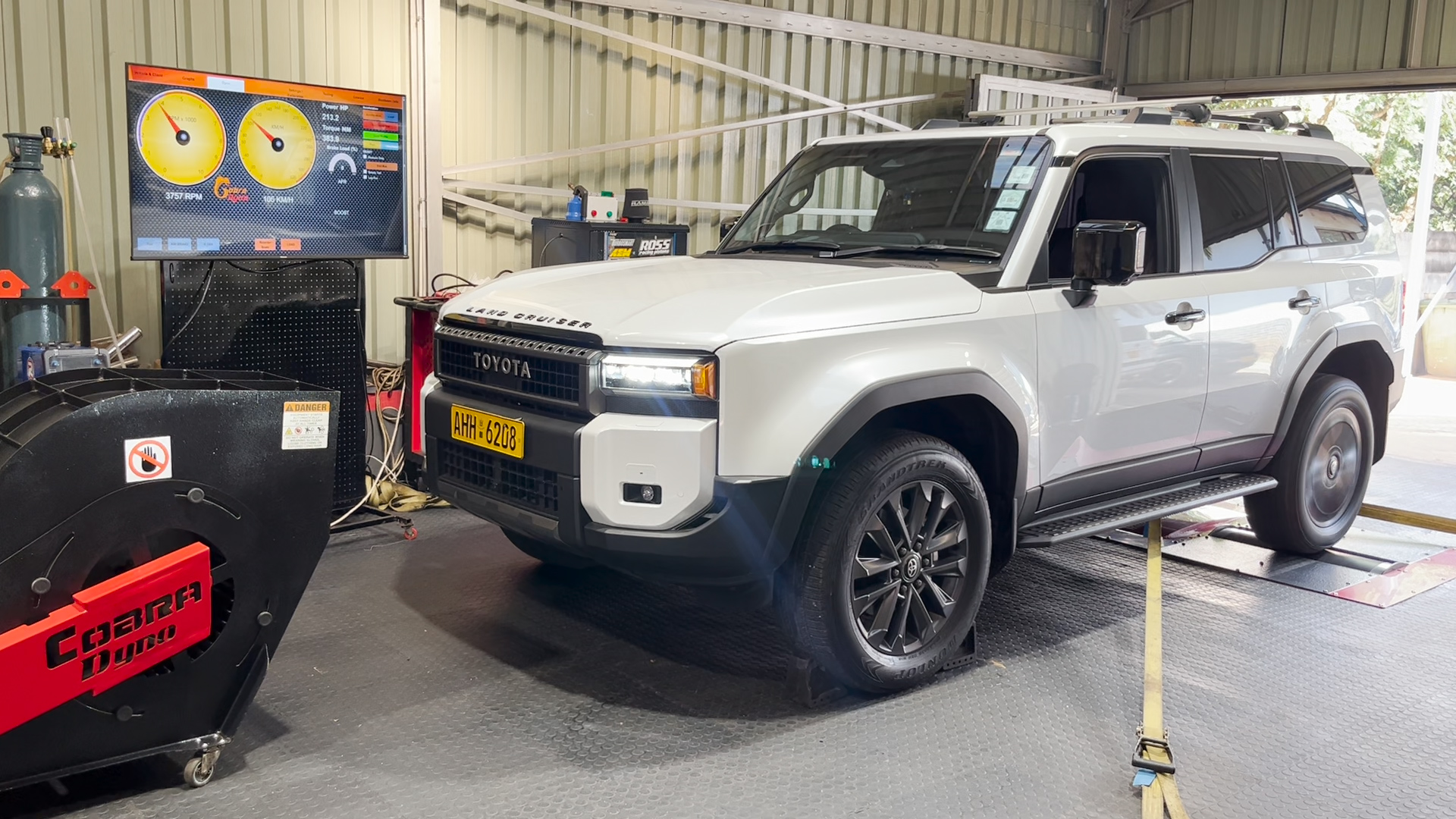
Let’s start with the standard Prado 250. This example arrived completely stock – factory exhaust, factory turbo, factory injectors.
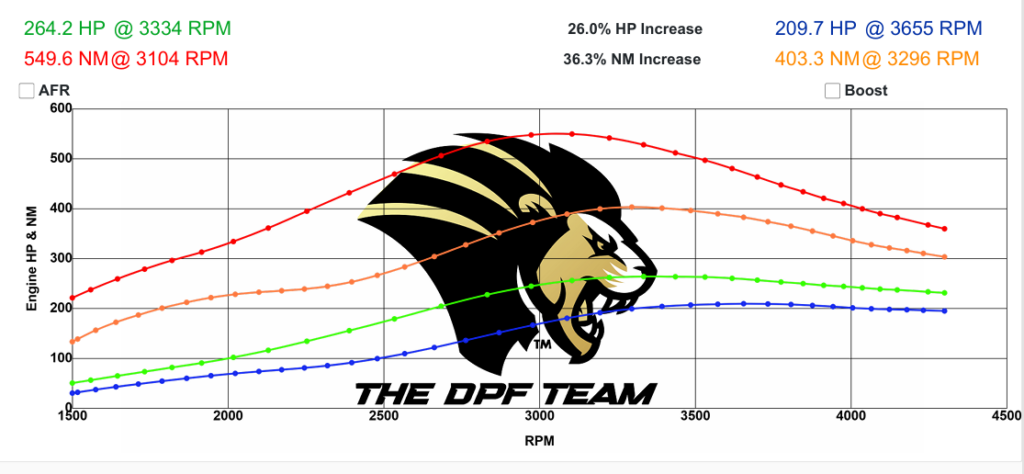
Our baseline pull (with DPF and AdBlue still active): 209 horsepower and 403 Newton‑metres of torque.
That’s typical for a 1GD in factory emission‑compliant form. The engine is capable of much more – but manufacturers strangle them to pass worldwide Euro 6 standards.
The Kakadu 48V Mild‑Hybrid – A Different Story
We also tested the Kakadu version, which adds a 48V mild‑hybrid system. This technology is designed to improve responsiveness – and it shows.
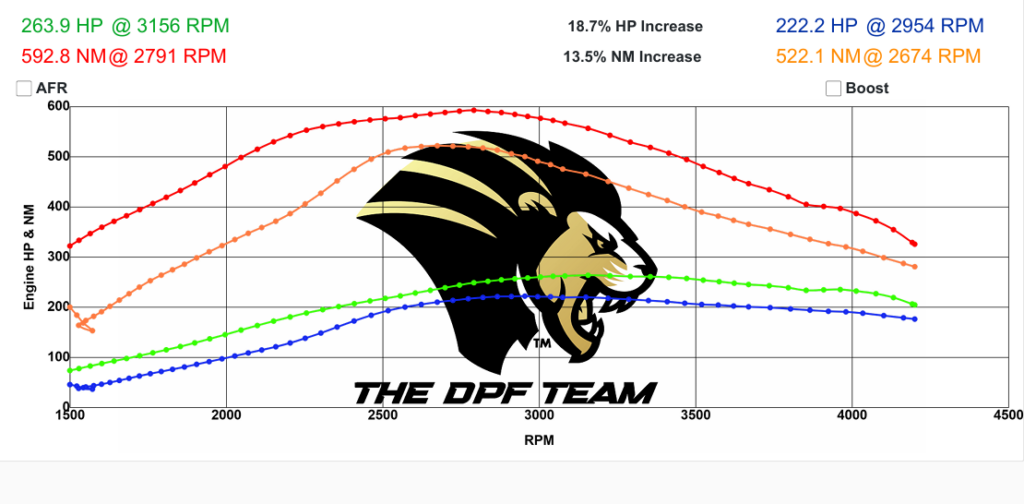
Our baseline pull on the Kakadu (still with DPF/AdBlue, but hybrid active): 222 horsepower and 522 Newton‑metres of torque.
That’s +13hp and +119Nm over the standard Prado, before any tuning. The electric assistance fills in the low‑end torque and helps the turbo spool faster. It’s a genuine advantage.
Our Tuning Process – DPF/AdBlue Removal (Legal in Zimbabwe)
Before loading any calibration, we performed two essential modifications on both vehicles:
DPF (Diesel Particulate Filter) removal
AdBlue (SCR) system removal
Here in Zimbabwe, these emission regulations do not apply. Removing these systems is perfectly legal. And for the 1GD engine, it is critical for reliability because:
The DPF clogs over time, increasing backpressure and exhaust gas temperatures
AdBlue systems can fail expensively and leave you stranded
Removing them allows the engine to breathe freely and run cleaner
After removal, we then calibrated the ECU to take full advantage of the freed‑up exhaust flow.
The Results – Standard vs Kakadu
Model
Stock Power
Stock Torque
After Tune (DPF/AdBlue removed)
Gain
Standard Prado
209hp
403Nm
264hp / 549Nm
+55hp / +146Nm
Kakadu 48V
222hp
522Nm
264hp / 592Nm
+42hp / +70Nm
Notice that both versions end at the same peak power (264hp) – because the turbo and injectors are the same hardware bottleneck. But the Kakadu achieves significantly more torque (592Nm vs 549Nm) thanks to the 48V system filling in the low‑end and mid‑range.
This is a perfect demonstration of how mild‑hybrid technology works to its advantage. The electric assistance doesn’t raise the peak power ceiling (that’s still set by the turbo/fuel system), but it transforms the area under the curve – especially torque delivery.
Before & after: No smoke. Just clean, reliable power. Watch the dyno runs. (Link to video)
The Myth of Diesel Smoke (Busted)
Many people believe that tuning a diesel automatically makes it roll coal. That is far from the truth – if the tuner knows what they are doing.
Smoke comes from over‑fueling without enough air. A proper calibration matches fuel delivery to the available air (boost). On both Prados, even after removing the DPF and AdBlue and adding our tune, there was no smoke whatsoever before, during, or after the pull.
You can see this clearly in the before/after video. Clean exhaust, clean power, clean conscience.
What About Fuel Economy?
We don’t usually lead with fuel savings because that’s not why most people tune with us. But diesel is different from petrol.
Petrol vehicles – tuning often increases fuel consumption slightly because you’re using more air and fuel to make more power.
Diesel vehicles – because we remove restrictions and optimise combustion efficiency, many owners report better kilometres per litre after tuning, especially at highway cruising speeds.
We won’t promise a specific number – driving habits vary too much. But you will not see any adverse change in fuel consumption. The likely outcome is a modest improvement.
Stock Hardware Limits (What We Didn’t Upgrade)
On both Prados, we achieved these results using:
✅ Factory turbocharger
✅ Factory injectors
✅ Factory exhaust (stock diameter, stock muffler)
The 1GD’s immediate ceiling is exactly what the turbo and injectors can flow. We are right at that limit – safely – without overspeeding the turbo or exceeding injector duty cycles.
The Kakadu’s 48V system helps with responsiveness and low‑end torque, but it does not change the turbo or injector limits. That’s why peak power (264hp) is identical between the two, but torque is higher on the hybrid.
What About an Upgraded Exhaust?
While the stock exhaust is fine for 264hp, there is one scenario where we recommend an upgrade: heavy towing.
If you regularly tow a caravan, horse float, or heavy trailer, exhaust gas temperatures (EGTs) become critical. A larger‑diameter exhaust (or a freer‑flowing muffler) helps lower EGTs, protecting the turbo during prolonged high‑load operation.
What does an exhaust upgrade add?
Approximately 3–5% more torque in the mid‑range (where you feel it during overtaking or climbing)
Overall peak power remains the same – because the turbo and injectors are still the bottlenecks
So if you’re a weekend warrior who occasionally tows, the stock exhaust is fine. If you tow every week, invest in an exhaust for reliability.
The Crazy Few – Going Beyond 264hp
For 99% of Prado 250 owners, 264hp is more than enough – whether standard or Kakadu. The car feels transformed: effortless overtaking, stronger towing, and much more responsive throttle. The Kakadu, with its 592Nm of torque, is particularly urgent.
But maybe you’re part of the crazy few who want more. To go beyond the stock turbo and injectors, you would need:
Upgraded turbocharger (larger compressor or hybrid)
Larger injectors (or higher fuel pressure)
Intercooler upgrade (to manage intake temps)
Transmission recalibration (the automatic has torque limits)
We are happy to develop such a setup with you. But be warned – it’s a deep rabbit hole. Most people find the 264hp jump to be a handful already.
[SECOND VIDEO EMBED – OPTIONAL]
If you have a video of the Kakadu driving on road or towing after the tune, insert it here. Caption below:
Kakadu 48V on‑road: 592Nm of torque – the hybrid advantage in action. (Link to video)
The Bottom Line (For Prado 250 / 1GD Diesel Owners)
Model
Stock Power/Torque
After Tune (DPF/AdBlue removed)
Notes
Standard Prado
209hp / 403Nm
264hp / 549Nm
+55hp / +146Nm – no smoke, reliable
Kakadu 48V
222hp / 522Nm
264hp / 592Nm
+42hp / +70Nm – hybrid gives higher torque
Both (with exhaust upgrade)
Same as above
Same peak power, +3–5% mid‑range torque
Recommended for heavy towing
Beyond 264hp
Turbo + injectors + intercooler + transmission
Crazy few only – contact us to develop together
No stages. Just honest diesel tuning – and a clear demonstration of what the 48V mild‑hybrid really adds.
[OUTRO IMAGE SUGGESTION: Side‑by‑side dyno graphs of standard vs Kakadu, or a shot of a clean exhaust exit with caption “Clean diesel – no smoke”]
Ready for Your Prado 250 (Standard or Kakadu)?
If you own any Prado 250 series with the 1GD engine – whether standard or the 48V mild‑hybrid – and you want:
A safe, reliable 20–30% power gain (and even more torque on the Kakadu)
DPF and AdBlue removal (legal in Zimbabwe)
No smoke, possible fuel savings, and transformed drivability
…reach out. We’ll give you a no‑BS recommendation based on your specific vehicle and your towing needs.
And if you want to be one of the crazy few who pushes past 264hp? Let’s talk. We’re happy to develop that with you.