
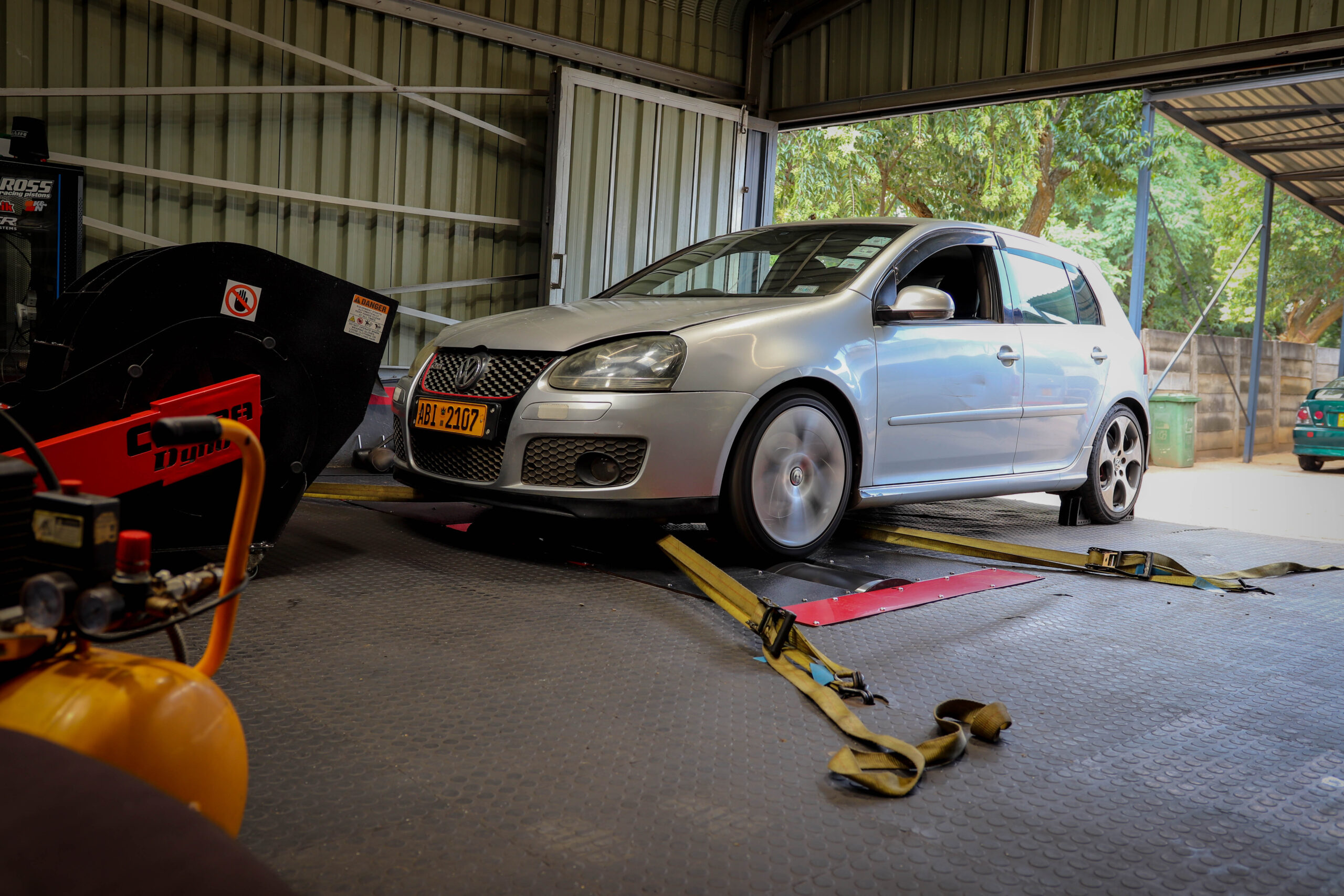
This Mk5 GTI arrived at our shop already wearing a couple of thoughtful modifications. It had an aftermarket intake system and a full 3-inch exhaust from the turbo back. That’s important to mention because those changes actually helped the car breathe better than a completely stock example.
Our baseline dyno pull (before touching the ECU):
215 horsepower and 359 Newton-meters of torque.
For context, factory rating on these cars is around 197–200hp depending on the market. So the intake and exhaust alone gave it a small but meaningful bump before we even started tuning.
Our “Peak OEM Capacity” Calibration
We loaded our calibration file – what some shops would incorrectly call a “Stage 1” – but let’s be precise about what we actually did:
- We increased boost pressure safely within the stock K03 turbo’s efficiency range
- We adjusted fuel mapping to match, staying well within stock injector duty cycle limits
- We optimized ignition timing for the customer’s local fuel quality
- We kept all factory safety systems active (torque limits, EGT protection, knock control)
The result after tuning:
263 horsepower and 394 Newton-meters of torque.
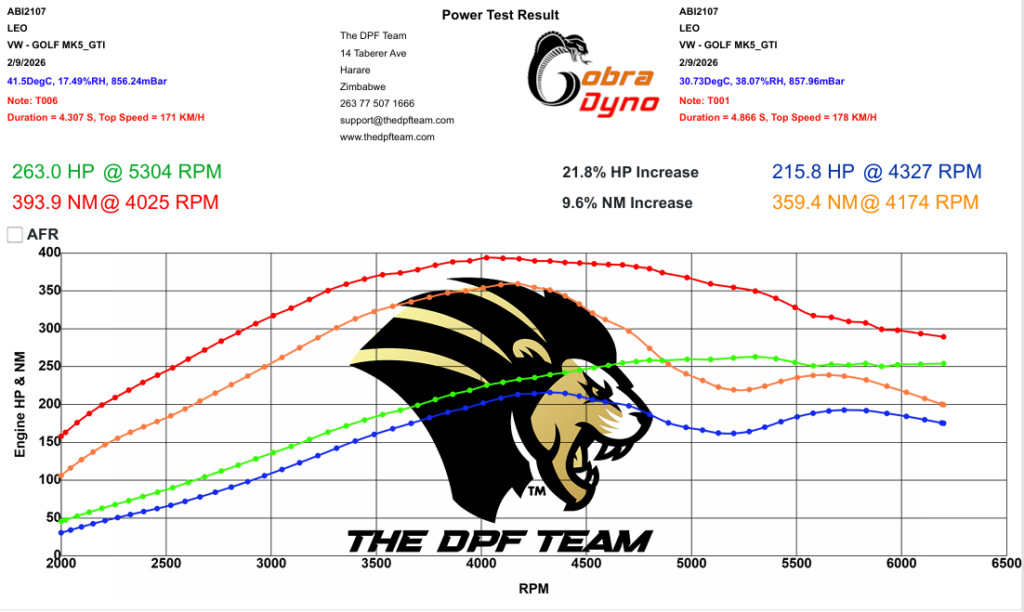
That’s a gain of 48 horsepower and 35 Nm of torque – roughly 20% additional power over the car’s already-enhanced baseline.
More importantly, every single number on that dyno graph represents a safe outcome. Injectors not maxed. Turbo not overspun. No knock. No pulled timing. Just clean, repeatable power.
Above is a clip of the Golf Mk5 being tested on our inhouse chassis dyno
But What If You Want More? (Breaking the Bottleneck)
Here’s where the “stage” terminology completely falls apart. Because the car above? It’s done. On the stock turbo and stock injectors, there is nothing left to safely give.
We have pushed this exact engine platform further in the past – up to 283 horsepower – but not without changing the biggest bottleneck.
The factory K03 turbocharger physically cannot flow enough air above 260–270hp territory without overspinning and destroying itself. That’s not a tuning limitation. That’s physics.
To go beyond 263hp on this engine, you must upgrade the turbocharger.
Specifically, we have had excellent results with the BorgWarner KKK K04 turbocharger (an OEM+ upgrade from the Audi S3 / Golf R family). With that turbo fitted, combined with our expert calibration, we have safely produced 283 horsepower from this same 2.0T FSI engine.
That extra 20 horsepower doesn’t sound like much on paper – but the area under the curve transforms. The K04 holds boost to redline. The factory K03 gasps past 5,500rpm. That’s the difference. With better technology turbo in 2026 it should be possible to see peak power in excess of 300hp
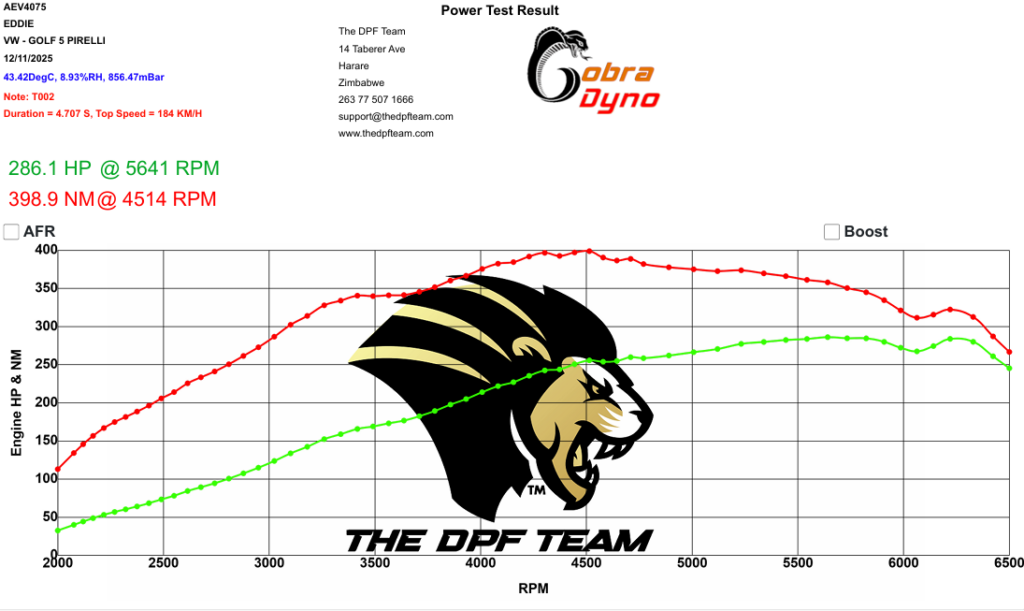
Want to see the K04 comparison? We’ll post that graph separately. Subscribe to get notified.
The Bottom Line
| What you’ve been told | What we actually mean |
|---|---|
| “Stage 1” | Peak safe power on stock turbo + stock injectors |
| “Stage 2” | Finally upgrading the turbo – the only way to truly move the goalposts |
| “Stage 3” | Radial changes to the engine internals and fuel system to handle higher loads |
On this 2006 Golf GTI Mk5:
- ✅ 263hp / 394Nm – Maximum safe output on factory hardware
- ⚠️ 283hp – Requires BorgWarner K04 turbo upgrade + our tuning
No confusion. No marketing fluff. Just the actual bottleneck, clearly stated.
Ready for Your Tune?
If you own a Mk5 GTI (or any turbo vehicle) and you want the absolute most your stock hardware can safely deliver – without someone selling you “Stage 2” stickers and fairy tales – contact us.
We’ll tell you exactly where your bottleneck is. Then we’ll tune right up to it.
And when you’re ready to break that bottleneck? We’ll be here with a turbo upgrade and a calibration to match.